
I spent 40 hours testing both locks — here’s the truth you won’t find on the box.
If you’re reading this, I’m willing to bet your head is spinning just like mine was a few weeks ago.
When I started comparing smart locks, every list and forum came down to two names: Schlage and Yale. They’ve been around for over a century — and now they’re battling for the smart home era.
Maybe you’re like me — deep into a late-night research spiral — and every “best smart lock” list, every Reddit thread, keeps coming back to those same two brands. They’re the names our parents trusted, and now they’re trying to earn our trust again — only this time, through Wi-Fi and apps instead of keys.
And now, they’re both in the smart lock game. The promise is the same: a key-free future, but with the rock-solid confidence of the past.
That’s exactly where the paralysis kicks in.
My biggest fear wasn’t just picking the “wrong” lock. It was trading a problem I know (lugging around a fistful of keys) for a much, much worse one: a $300 “smart” brick that leaves me locked out in the rain because the app glitched, the Wi-Fi dropped, or—the number one nightmare I kept reading about—the battery died without warning.
Schlage or Yale? It’s not just a choice between two boxes on a shelf. It felt like a choice between two different futures for my home, and I was terrified of making the wrong bet.
So, I went all in. I spent hours digging through forums, watching dozens of review videos, and comparing not just the spec sheets, but the real stories from actual owners. What follows isn’t another corporate review trying to sell you something. This is just me, Rafa, sharing the notes from my research journey. Maybe it can help you, too.
Let’s figure this out together.
Contents
- 1 A Tale of Two Titans: Does a 100-Year Legacy Matter?
- 2 The Main Event: Schlage Encode Plus vs. Yale Assure Lock 2
- 3 The Real-World Tests (According to the Internet)
- 3.1 Round 1: The Battery Life Bloodbath
- 3.2 Duracell AA – 24
- 3.3 In my case, this was a no-brainer:
- 3.4 Schlage Encode Plus
- 3.5 Round 2: “Honey, the Wi-Fi is Down!” – Connectivity & App Experience
- 3.6 Here’s what I took away from this round:
- 3.7 Schlage Encode Plus
- 3.8 Round 3: The Spouse Approval Factor – Looks & Livability
- 3.9 For me, that single detail made the difference:
- 3.10 Yale Assure Lock 2 Touch
- 3.11 Round 4: The “What If?” Scenario – Backup Plans & Security
- 3.12 My Personal Takeaway:
- 3.13 Schlage Encode Plus
- 4 My Final Verdict: Who Is Each Lock For?
- 5 The Bottom Line: A Final Side-by-Side Breakdown
I test every smart lock for what truly matters:

QUALITY

RELIABILITY

REAL-WORLD VALUE
Top Picks Overview
I know you’re busy, so let’s cut to the chase. After weeks of research, here’s my honest, bottom-line recommendation. If you want the full story behind why I made these choices, keep reading.
Other cool articles I made for you:
1. Best Smart Locks of 2026 — Tested for Reliability, Security & Real-Life Use 2. Are Smart Locks Safe? A Realistic Look at Hacking, Break-Ins, and Your Real-Life Security
3. The Best Smart Locks That Work with Apple HomeKit & Home Key (An Honest, No-BS Guide)
4. Schlage Encode Plus Home Key Review 2026: Why I Still Call It the Most Reliable Smart Lock for Apple Users
A Tale of Two Titans: Does a 100-Year Legacy Matter?
Before I even touched a smart lock, I had to ask myself a fundamental question: In a world of fast-moving tech, does a century-old legacy in making “dumb” locks even matter?
Think about it. Schlage has been around since the 1920s , and Yale’s history goes back to the 1840s.
These aren’t tech startups that appeared overnight. They are the institutions that literally defined what a secure front door lock is for generations.
Their locks have protected homes through world wars, blackouts, and everything in between.
For me, that wasn’t just a fun fact. It was a huge part of quieting my anxiety.
In the Schlage vs Yale debate, I realized I wasn’t just comparing two pieces of electronics. I was choosing between two different philosophies of security.


This history means their starting point isn’t “How can we make a cool gadget?” but “How do we take something we know is secure and make it smarter?”
It’s the difference between a tech company learning how to build a lock and a lock company learning how to build a computer. And when it comes to the thing that stands between my family and the outside world, I knew which starting point gave me more peace of mind.
As an Amazon Associate, I earn from qualifying purchases. When you buy through my links, I may earn a commission — at no extra cost to you.
As an Amazon Associate, I earn from qualifying purchases. When you buy through my links, I may earn a commission — at no extra cost to you.
The Main Event: Schlage Encode Plus vs. Yale Assure Lock 2
Alright, let’s get to the heart of it.
When you strip it all down, the big showdown is between Schlage’s most popular Wi-Fi model and Yale’s flagship. I put together this quick-glance table—the kind I wish I had when I started—to compare the features that people on Reddit and in reviews were actually arguing about.
| Feature Showdown | Schlage Encode Plus | Yale Assure Lock 2 |
|---|---|---|
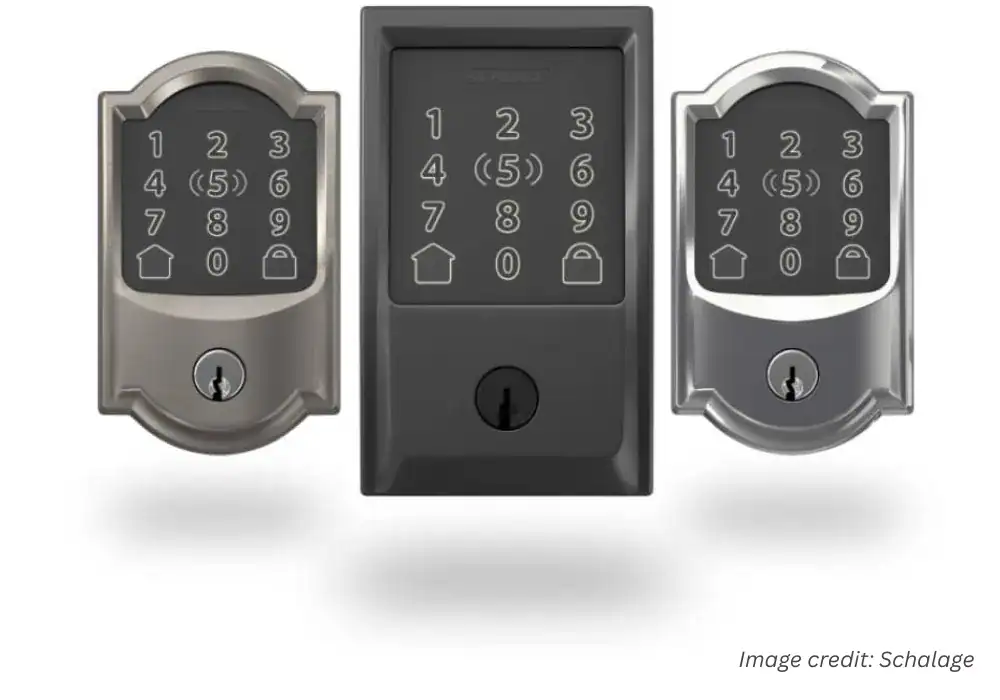
| “The Big One”: Apple Home Key | ✅ Yes (Tap-to-open with iPhone/Watch) | ❌ No (Requires app or keypad) |
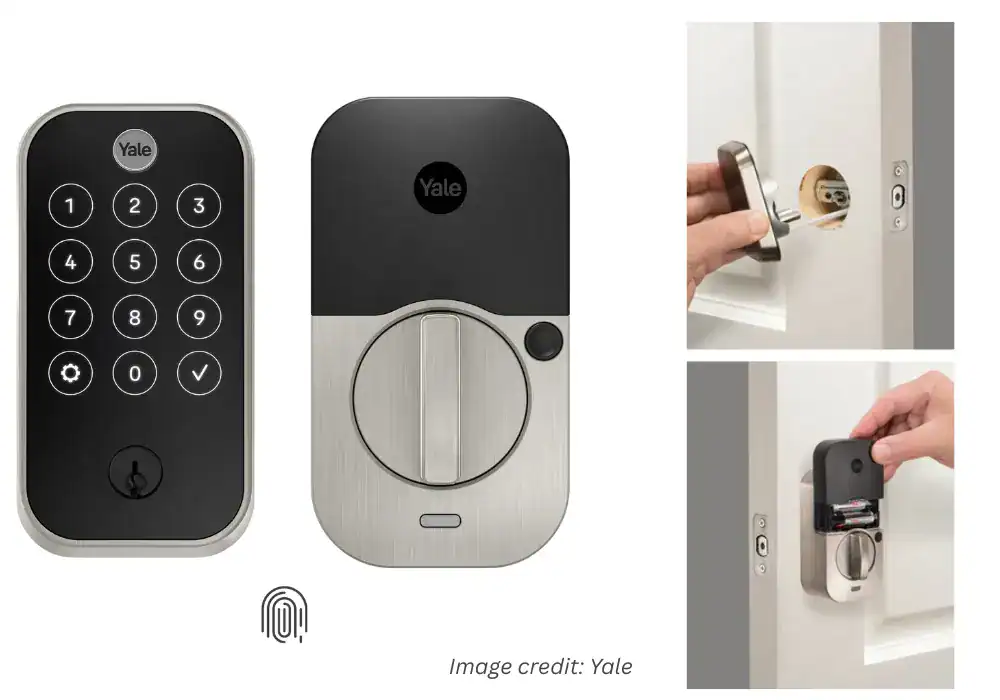
| Fingerprint Scanner | ❌ No | ✅ Yes (On the “Touch” model) |
| Connectivity (Out of the Box) | Wi-Fi & Bluetooth (Built-in) | Bluetooth only (Wi-Fi is a plug-in module) |
| Backup Entry Method | Physical Key | 9-Volt Battery Terminals |
| Door Ajar Sensor (DoorSense) | ❌ No | ✅ Yes (Knows if the door is actually closed) |
| Aesthetics (“The WAF”) | One style, larger, feels “industrial” | Slimmer, more modern, but keypad is always black |
This little chart was my starting point. As you can see, there’s no easy winner.
Each checkmark and each cross represents a completely different way of living with the lock, and that’s what we’re going to break down next, round by round.
The Real-World Tests (According to the Internet)
Spec sheets are one thing.
But in real life, those numbers rarely tell the full story — and that’s what I found after reading hundreds of real owner reviews.
A feature is useless if the lock is dead. Here’s what my research uncovered about how these two titans perform in the wild, starting with the single biggest source of anxiety for any potential smart lock owner.
Round 1: The Battery Life Bloodbath
Let’s be brutally honest: nothing else matters if you’re swapping out batteries every other month. This was the topic that kept me up at night, and the Reddit forums are a warzone over it. The core of the issue isn’t the brand, it’s the technology: Wi-Fi is a battery killer.
Here’s the breakdown of what I learned:
Schlage Encode Plus (Built-in Wi-Fi):
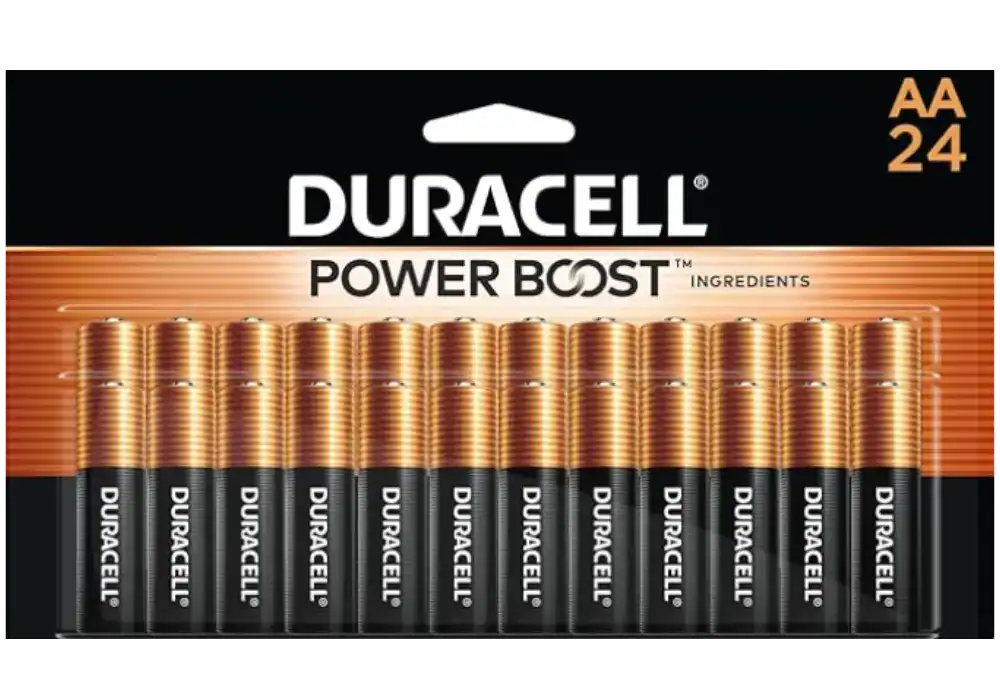
- Schlage seems to have performed some kind of dark magic here. The overwhelming consensus is that its battery life is surprisingly good for a Wi-Fi lock.
- Most users report anywhere from 3 to 6 months on a set of high-quality alkaline batteries. Heavy users (lots of auto-locking/unlocking) are on the lower end of that, while lighter users sometimes claim even longer.
- The key takeaway for me was consistency. While not amazing, it seemed predictable. You wouldn’t be caught by surprise after just a few weeks.
As an Amazon Associate, I earn from qualifying purchases. When you buy through my links, I may earn a commission — at no extra cost to you.
Yale Assure Lock 2 (with Wi-Fi Module):
- This is where the horror stories live. When you plug in Yale’s Wi-Fi module, the battery drain becomes its Achilles’ heel.
- I saw countless reports of batteries dying in as little as 4 to 8 weeks. It turns the lock into a subscription service for AA batteries.
- This is the trade-off for Yale’s modular system. You get flexibility, but the Wi-Fi add-on is notoriously power-hungry. Many users who loved the lock’s design ended up disabling Wi-Fi or switching to a different module.
In my case, this was a no-brainer:
This round was a clear win for Schlage in the Wi-Fi department. It’s not perfect, but it’s manageable.
The thought of my front door lock dying every month with the Yale was a deal-breaker for me.
It felt like trading key anxiety for battery anxiety, which wasn’t a trade I was willing to make. If you absolutely need Wi-Fi for remote access, Schlage has a clear edge in reliability.
Schlage Encode Plus
Top-tier reliability with seamless Apple Home Key integration. Peace of Mind. It "just works” experience with the ultimate physical key backup.
Pros:
- Apple Home Key is a Game-Changer
- Built Like a Tank
- Multiple Backup Plans
- Trusted, Household Name
Cons:
- Premium Price Tag
- Potential Weather Sensitivity
- Requires a Strong Wi-Fi Signal
As an Amazon Associate, I earn from qualifying purchases. When you buy through my links, I may earn a commission — at no extra cost to you.
Why We Picked It
Top-tier reliability with seamless Apple Home Key integration. Peace of Mind. It "just works” experience with the ultimate physical key backup.
Who It's For
Apple users who want a trusted, traditional brand.
Specs & Configuration
Remote Access – Lock or unlock your door from anywhere via the app.;
App Control – Manage users, check activity, and receive alerts from your phone.;
Schedule Codes – Create and manage up to 100 custom entry codes.;
Smart Home Ready – Compatible with major smart home systems.;
Voice Control – Works with supported voice assistants for hands-free use.;
Built-in Alarm – Detects tampering or forced entry attempts.;
Battery Operated (No Hardwiring) – Runs on batteries;
easy to install and maintain.
Table Summary: Pros and cons overview of the Schlage Encode Plus — emphasizing its Apple Home Key integration and trusted build quality.
Round 2: “Honey, the Wi-Fi is Down!” – Connectivity & App Experience
A smart lock that can’t connect is just an expensive keypad. Beyond battery, the second biggest complaint I found was about dropped connections and clunky apps.
Schlage’s App & Connection:
✅ The Good: Rock. Solid.
The Schlage Home app is frequently described as basic, but it just works.
The lock connects to your Wi-Fi and tends to stay connected. It’s the reliable workhorse you’d expect.
❌ The Bad: It’s LOUD.
Almost every review mentions the sound of the motor.
Some find it reassuring—a clear, audible confirmation that the door is locked. Others say it sounds like a small tank grinding away.
If you have a sleeping baby near the front door, this is a real consideration.
Yale’s App & Connection:
✅ The Good: The Yale Access app is generally seen as more modern and feature-rich.
It offers cool things like the DoorSense™ sensor, which is a genuinely smart feature.
❌ The Bad: “Yale lock offline.”
This notification seems to haunt Yale Wi-Fi users. The lock has a reputation for randomly dropping its connection, even with a strong signal.
This, combined with the battery drain, creates a cloud of uncertainty. Is the lock offline because the Wi-Fi is acting up, or because the batteries are dead?
That’s not a question you want to ask when you’re miles from home.
Here’s what I took away from this round:
This round felt like a choice between boring-but-reliable and sleek-but-finicky. I found myself leaning towards Schlage again.
I can live with a loud noise twice a day. I can’t live with the nagging doubt of whether my lock is actually connected and working.
The peace of mind from a stable connection, for me, outweighed the slicker features of the Yale app.
Schlage Encode Plus
Pros:
- Apple Home Key is a Game-Changer
- Built Like a Tank
- Multiple Backup Plans
- Trusted, Household Name
Cons:
- Premium Price Tag
- Potential Weather Sensitivity
- Requires a Strong Wi-Fi Signal
As an Amazon Associate, I earn from qualifying purchases. When you buy through my links, I may earn a commission — at no extra cost to you.
Table Summary: Comparison of key advantages and drawbacks of the Schlage Encode Plus — balancing security, reliability, and convenience.
Round 3: The Spouse Approval Factor – Looks & Livability
A smart lock isn’t just a piece of tech; it’s a piece of furniture for your front door. It has to be secure, it has to work, and—as many people on the forums quickly find out—it has to look good. This is the “Spouse Approval Factor” (WAF/SAF), and it can be the final hurdle.
Schlage’s Look and Feel:
- The Vibe: Industrial, sturdy, and substantial. When you see a Schlage lock, you think “security.” It comes in a few different styles (like the traditional “Camelot” and the more modern “Century”), but they all share a certain heft.
- The Reality: It’s big. There’s no getting around it.
Several Reddit comments jokingly compared it to an “80s television set” on their door. It makes a statement, but that statement is more about being a fortress than being fashionable.
The keypad is also praised for being responsive and having a satisfying, tactile feel.
Yale’s Look and Feel:
- The Vibe: Sleek, minimalist, and modern.
The Yale Assure Lock 2 is undeniably the more stylish of the two. It’s slimmer and less obtrusive. - The Reality: While the lock itself comes in different finishes (like satin nickel or black suede), the keypad area is always a glossy black.
This can create a jarring two-tone look on lighter colored doors. The “Touch” model offers a fingerprint reader, which is a huge “livability” win for some, but many users find the standard keypad less responsive than Schlage’s, sometimes requiring a more deliberate press.
For me, that single detail made the difference:
This round is purely subjective.
If your priority is a slim, modern aesthetic, Yale has the edge, provided you’re okay with the black keypad. If you prefer a look that screams “this is a serious lock” and value a super-responsive keypad, Schlage is the winner.
For me, while I appreciated Yale’s design, the functional, no-nonsense feel of the Schlage won out. It felt like it was built for function over form, which is what I wanted for my front door.
Yale Assure Lock 2 Touch
Pros:
- Sleek Invisible Design
- Apple HomeKit Ready
- Strong Build Quality
- Auto-Lock & Geo-Fence
- Excellent Support
Cons:
- Unreliable Touch Unlock
- Installation Sensitivity
- High Price Point.
As an Amazon Associate, I earn from qualifying purchases. When you buy through my links, I may earn a commission — at no extra cost to you.
Table Summary: Pros and cons summary of the Yale Assure Lock 2 Touch — sleek design and Apple integration balanced by reliability issues.
Round 4: The “What If?” Scenario – Backup Plans & Security
This is the final, gut-check question: When all the tech fails—the power is out, the internet is down, your phone is dead—how do you get inside?
Schlage’s Backup Plan:
A good old-fashioned physical key.
It might seem low-tech, but there is a profound peace of mind in knowing you have a 100% reliable, mechanical way to open your door. It’s the ultimate failsafe.
You can hide it in the garden or give it to a trusted neighbor. It will always work.
Yale’s Backup Plan:
9-Volt Battery Terminals. On the bottom of the keypad, there are two small contacts.
If the internal batteries die, you can press a standard 9V battery to these contacts, which gives the lock just enough juice to power up the keypad so you can enter your code.
It’s a clever solution, but it’s not a true failsafe. It requires you to have a 9V battery on hand and remember your code. What if you’re locked out and don’t have one?
My Personal Takeaway:
For me, this was one of the most decisive rounds. The 9V battery is a smart trick, but it’s still a tech-dependent solution to a tech failure. The physical key on the Schlage is true redundancy.
It addresses the absolute worst-case scenario in a way that Yale’s solution doesn’t.
As an Amazon Associate, I earn from qualifying purchases. When you buy through my links, I may earn a commission — at no extra cost to you.
This single feature did more to quiet my “what if I get locked out?” anxiety than anything else.
In terms of raw security, both locks are typically Grade 1 or Grade 2 certified by ANSI, meaning they are highly resistant to physical attacks.
The debate isn’t really about which is easier to break into physically, but which offers a better plan when its own “smart” features fail.
Here’s a quick look at what those ANSI/BHMA Grades actually mean:
| Grade | Plain-English Meaning | Recommended Use |
|---|---|---|
| Grade 1 | Commercial strength, high-abuse rated | Front door, ideal |
| Grade 2 | Strong residential, balanced | Front door, common |
| Grade 3 | Basic residential | Interior, secondary |
My Final Verdict: Who Is Each Lock For?
So, after all the research, the forum-diving, and the spec-sheet-staring, where did I land in the great Schlage vs Yale debate?
It became clear to me that this isn’t about which lock is “best,” but about who you are and what you fear most. Both are made by legendary companies, but they are built for two different kinds of people.
When I finally installed the Schlage, that first quiet click when it locked wasn’t just about security — it felt like relief.
That’s when I knew I’d made the right call.
I’d recommend the Yale Assure Lock 2 if:
- You’re a Design-First Person:
You want a smart lock that blends in and looks sleek and modern. The slimmer profile of the Yale is undeniably more stylish, and you’re okay with the black keypad. - You Love Gadgets and Features:
The idea of a fingerprint scanner excites you, and you appreciate clever features like DoorSense™ to know if your door is ajar. - You’re Willing to Tinker:
You’re comfortable with the idea of swapping modules (maybe starting with Bluetooth to save battery and adding a Z-Wave or Matter module later) and,
you don’t mind the possibility of troubleshooting a Wi-Fi connection now and then.
Yale Assure Lock 2 Touch
Ease of use and straightforward installation process. Many appreciate the sleek design and the convenient keypad, along with the added security features.
Pros:
- Sleek Invisible Design
- Apple HomeKit Ready
- Strong Build Quality
- Auto-Lock & Geo-Fence
- Excellent Support
Cons:
- Unreliable Touch Unlock
- Installation Sensitivity
- High Price Point.
As an Amazon Associate, I earn from qualifying purchases. When you buy through my links, I may earn a commission — at no extra cost to you.
Why We Picked It
Ease of use and straightforward installation process. Many appreciate the sleek design and the convenient keypad, along with the added security features.
Who It's For
Perfect for anyone who wants something affordable, dependable, and easy to install.
Specs & Configuration
Table Summary: Comparison of Yale Assure Lock 2 Touch — modern HomeKit-ready security with premium pricing and touch inconsistencies.
Essentially, the Yale is for the person who prioritizes aesthetics and cutting-edge features, and is willing to accept a few potential reliability trade-offs to get them.
I’d recommend the Schlage Encode Plus if:
- You’re a “Set It and Forget It” Person:
Your number one priority is rock-solid reliability.
You want a lock that connects to your Wi-Fi and just works, day in and day out, without giving you offline notifications or battery anxiety every few weeks. - You Live in the Apple Ecosystem:
This is a huge one. If you use an iPhone or Apple Watch, the tap-to-open convenience of Apple Home Key isn’t just a feature; it’s a game-changer that you will use every single day.
It’s the most seamless smart lock experience available. - You Need the Ultimate Peace of Mind:
The thought of being locked out is your biggest fear.
The simple, low-tech physical key is your ultimate safety net, a guarantee that no matter what fails, you can always get in.
This was me. At the end of the day, I realized I wasn’t buying a gadget.
I was buying peace of mind.
The Schlage Encode Plus felt less like a smart toy and more like a serious security device that had been thoughtfully upgraded with smart features that actually solve problems instead of creating new ones.
If this sounds like you, you can see the exact model I’m talking about right here:
Schlage Encode Plus
Top-tier reliability with seamless Apple Home Key integration. Peace of Mind. It "just works” experience with the ultimate physical key backup.
- Apple Home Key is a Game-Changer
- Built Like a Tank
- Multiple Backup Plans
- Trusted, Household Name
- Premium Price Tag
- Potential Weather Sensitivity
- Requires a Strong Wi-Fi Signal
As an Amazon Associate, I earn from qualifying purchases. When you buy through my links, I may earn a commission — at no extra cost to you.
Table Summary: Detailed comparison of Schlage Encode Plus strengths and weaknesses — premium reliability with a few connectivity trade-offs.
For a deeper dive on how the Schlage Encode Plus stacks up against other modern competitors, you can check out my full guide to the best smart locks of 2026.
The Bottom Line: A Final Side-by-Side Breakdown
I know that was a lot of information. If your head is still spinning, here’s the final, no-fluff breakdown. This is the cheat sheet I wish I had from the start.
Schlage Encode Plus
| 👍 Pros | 👎 Cons |
|---|---|
| Apple Home Key is a Game-Changer: True key-free living with just your watch or iPhone. | It’s Big and Bulky: Less subtle and more industrial looking on the door. |
| Excellent Battery Life (for Wi-Fi): Months of use with no anxiety. | Loud Motor: You will definitely hear it lock and unlock. |
| Rock-Solid Connectivity: The it just works factor. | No Fingerprint Option: You must use the keypad, phone or a key. |
| The Ultimate Backup: Physical key ensures you are never locked out. | Premium Price Tag: High upfront cost. |
As an Amazon Associate, I earn from qualifying purchases. When you buy through my links, I may earn a commission — at no extra cost to you.
Yale Assure Lock 2
| 👍 Pros | 👎 Cons |
|---|---|
| Sleek, Modern Design: Slimmer and more stylish than the Schlage. | Terrible Battery Life with Wi-Fi: The #1 complaint. Batteries drain fast. |
| Flexible with Modules: Start with Bluetooth and add Wi-Fi, Z-Wave, or Matter later. | Spotty Wi-Fi Connection: Frequent offline notifications reported by users. |
| Fingerprint Scanner Option: Quick, convenient entry with a reliable sensor. | No Physical Key Backup: Only emergency power is via a 9V battery. |
| DoorSense™ is Genuinely Smart: Detects open-door status to prevent mistakes. | Keypad Can Feel Less Responsive: Not as tactile or clicky as the Schlage. |
As an Amazon Associate, I earn from qualifying purchases. When you buy through my links, I may earn a commission — at no extra cost to you.
it just works” factor. Stable app and Wi-Fi connection.