

Let’s start with a confession.
When I first thought about getting a smart lock, the cool factor was undeniable.
Are smart locks safe?
Unlocking the door with my watch?
Giving a temporary code to a friend?
It all sounded like the future I wanted. But then, late one night, as I was about to click “buy,” a thought crept in that sent a chill down my spine.
I wasn’t just replacing a piece of metal. I was plugging my front door—the very shield between my family and the outside world—into the internet. The thought of some random hacker unlocking my door from their laptop, or the lock simply failing and leaving my home vulnerable, was terrifying.
It felt like I was trading a known, reliable chunk of steel for a potential digital disaster.
That single question—”Are smart locks really safe?“—sent me down a rabbit hole of research.
I dug through Reddit forums, watched security expert breakdowns, and tried to separate Hollywood myths from real-world risks.
I’m not here to sell you a gadget.
I’m here to share what I found, honestly and directly, to help you answer that same question for yourself.
It’s been a journey, and I thought it was worth sharing a bit of it with you.
I’m not here to sell you a gadget.
I’m here to share what I found, honestly and directly, to help you answer that same question for yourself.
We’ll look at the real risks of hacking, the physical strength of these locks, and the simple truth about what actually keeps your home secure.
If you want a deeper dive into specific models, you can also check my full Best Smart Locks of 2026 guide or the Schlage vs Yale comparison where I tested both brands side by side.”
My goal is to replace that feeling of anxiety with clarity, so you can make a decision you feel genuinely confident about.
Before we dive deep into the security details, I want to be upfront about the locks I’ve come to trust through my research.
These are the models that consistently meet the high security standards we’ll be discussing.
If you’re wondering which locks pass the test, these are my top recommendations.
Contents
- 1 Let’s Be Honest: The Real Fear Isn’t Losing Keys, It’s Losing Control.
- 2 The Digital Threat: Can Your Smart Lock Actually Be Hacked?
- 3 The Physical Threat: Is a Smart Lock Weaker Than a “Dumb” Lock?
- 4 The Most Common Question: “Won’t They Just Break a Window?”
- 5 My Biggest Anxiety Wasn’t Hacking, It Was Failure: What if I Get Locked Out?
- 6 So, Are Smart Locks Safe? My Final Verdict.
Top Picks Overview
Other cool articles I made for you:
1. Best Smart Locks of 2026 — Tested for Reliability, Security & Real-Life Use
2. Schlage vs Yale (2026): Which Legacy Lock Brand Makes the Best Smart Lock?
3. The Best Smart Locks That Work with Apple HomeKit & Home Key (An Honest, No-BS Guide)
4. How to Install a Smart Lock (For When It’s Not as Easy as the YouTube Videos
Let’s Be Honest: The Real Fear Isn’t Losing Keys, It’s Losing Control.
It’s funny, isn’t it? We start looking for a smart lock because we’re tired of fumbling for keys. It’s a problem of convenience.
But the moment we get serious about it, that small annoyance is completely overshadowed by a much bigger, more primal fear: the fear of losing control.
That’s what it really boils down to.
The idea of my door lock being controlled by something I can’t see—a signal, a piece of code, the internet—was deeply unsettling.
A traditional key is simple.
It’s physical. You hold it, you turn it, it works. You understand it.
A smart lock introduces variables, and with them, a whole new set of “what ifs.“
1. What if the Wi-Fi goes down?
2. What if the app glitches?
3. What if someone, somewhere, can just type a command and let themselves in?
That last one is the real monster under the bed. It’s the Hollywood scenario that keeps us up at night.
So let’s tackle it head-on.
Because that’s the heart of the question most people ask: are smart locks safe from hackers or just another digital gimmick?
The Digital Threat: Can Your Smart Lock Actually Be Hacked?
This is the million-dollar question.
And the simple, technically correct answer is yes. Anything connected to a network is, in theory, hackable.
But that’s not the right question to ask. The right question is:
how likely is it, and is it the real threat I should be worried about?
Myth vs. Reality: The “Hollywood Hacker” Scenario
We’ve all seen it in the movies. A shadowy figure in a dark room, typing furiously on a glowing screen. Lines of code flash by, a “ACCESS GRANTED” message appears, and click—the high-security vault door opens.
It makes for great drama. But it’s a terrible representation of how real-world crime works.
I had to remind myself of one simple truth I found repeated over and over again by security professionals and reformed criminals alike: Burglars are business people, not cyber-warriors.
Their business is risk vs. reward. They are looking for the path of least resistance.
Think about it from their perspective. Which of these is a better business decision?
- Option A: Spend hours (or days) trying to bypass military-grade digital encryption on a single, specific front door, an act that requires immense technical skill and leaves a digital trail, all for an unknown payoff inside.
- Option B: Walk down the street to the next house, the one with the unlocked back window or the flimsy patio door, and be inside in 30 seconds with zero technical skill required.
The overwhelming majority of break-ins are crimes of opportunity.
A professional thief isn’t going to waste time on a digital fortress when a simple brick through a glass window is faster, easier, and far more predictable.
The “Hollywood Hacker” breaking into your specific smart lock is a myth.
The real digital threats, while they exist, are much less dramatic and, thankfully, much more preventable.
What About Tools Like the Flipper Zero? Understanding “Replay Attacks”
Okay, so the Hollywood hacker is out. But what about those videos I kept seeing on TikTok and Reddit?
Someone holds up a small, tamagotchi-like device called a Flipper Zero, captures a signal from a key fob, and then uses it to open a garage door or a car.
It works by recording the signal sent from your remote to the device. If the signal is always the same (a “static code”), the Flipper can just “replay” it later to unlock the door. This is how older, less secure garage door openers worked.
So, I had to know: could this work on a modern smart lock from a brand like Schlage or Yale?
The answer, to my immense relief, is a definitive no.
Here’s why.
Reputable smart locks don’t use a static code. They use something called rolling codes combined with powerful encryption.
Imagine your lock and your phone are secret agents.
Every time they talk, they use a new, secret password that will never be used again. Even if a device like a Flipper Zero is listening and records that password, it’s useless a second later. Trying to use it again would be like trying to use yesterday’s password to log into your bank account today. It just gets rejected.
On top of that, the communication itself is scrambled with something called AES (Advanced Encryption Standard). This is the same level of encryption used by banks, governments, and the military to protect classified information.
It’s designed to be unbreakable by brute force.
So, while tools like the Flipper Zero are powerful against simple, outdated technology, they are effectively useless against the rolling codes and robust encryption built into any quality smart lock.
This realization was a huge weight off my shoulders. The lock itself wasn’t the weak point I feared.
Which led me to the real vulnerability.
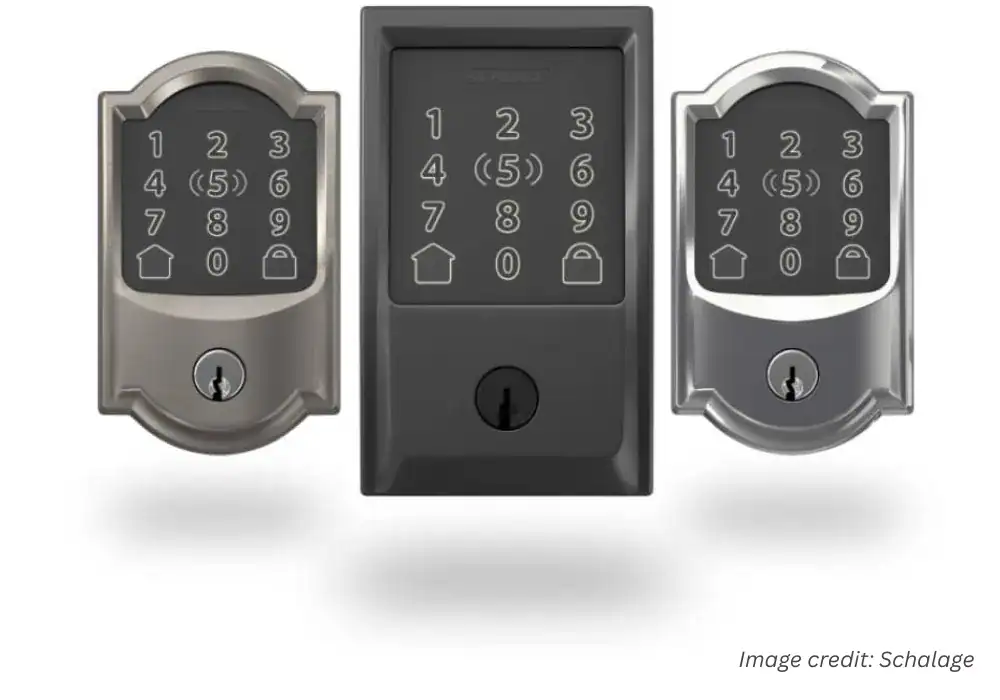
Schlage Encode Plus
Top-tier reliability with seamless Apple Home Key integration. Peace of Mind. It "just works” experience with the ultimate physical key backup.
Pros:
- Apple Home Key is a Game-Changer
- Built Like a Tank
- Multiple Backup Plans
- Trusted, Household Name
Cons:
- Premium Price Tag
- Potential Weather Sensitivity
- Requires a Strong Wi-Fi Signal
As an Amazon Associate, I earn from qualifying purchases. When you buy through my links, I may earn a commission — at no extra cost to you.
Why We Picked It
Top-tier reliability with seamless Apple Home Key integration. Peace of Mind. It "just works” experience with the ultimate physical key backup.
Who It's For
Apple users who want a trusted, traditional brand.
Specs & Configuration
Remote Access – Lock or unlock your door from anywhere via the app.;
App Control – Manage users, check activity, and receive alerts from your phone.;
Schedule Codes – Create and manage up to 100 custom entry codes.;
Smart Home Ready – Compatible with major smart home systems.;
Voice Control – Works with supported voice assistants for hands-free use.;
Built-in Alarm – Detects tampering or forced entry attempts.;
Battery Operated (No Hardwiring) – Runs on batteries;
easy to install and maintain.
Table Summary: Comparison of key advantages and drawbacks of the Schlage Encode Plus — balancing security, reliability, and convenience.
The Real Weak Link: Your Wi-Fi and Your Passwords
The security of a smart lock isn’t just about the lock itself. It’s about the entire system it connects to.
And the weakest link in that system is almost always us—the humans.
A hacker is infinitely more likely to get into your home network because of a weak, easily guessable password than they are to crack the encryption on the lock itself.
Think of it this way:
Schlage and Yale spent millions of dollars building a digital vault door (the lock). But if you leave the key to the entire building (your Wi-Fi password) under the doormat with a password like alexshouse123, the strength of the vault door doesn’t matter.
This is where we shift from being anxious consumers to empowered, responsible owners. Securing your smart lock is less about worrying about the lock and more about practicing good “digital hygiene.”
Here’s the simple checklist I now live by. It’s the most effective way to prevent any real-world digital security issues:
| Create an Unbreakable Wi-Fi Password | Use a Guest Network for Your IoT Devices | Enable Two-Factor Authentication (2FA) |
|---|---|---|
|
Tip: Avoid weak passwords like “Fluffy1998!”. Use one with at least 16 random characters — for example, “Blue-Giraffe-Jumps-!7-Lamps”. A password manager helps you generate and store it securely.
Why it matters: This is your first line of defense against attackers trying to access your network remotely. |
Tip: Most routers let you create a separate “guest” network. Connect all smart devices (locks, cameras, speakers) there — like a digital quarantine zone.
Why it matters: Even if one device is compromised, the hacker can’t reach your personal files or laptops on the main network. |
Tip: Turn on 2FA for any app controlling your lock (like Yale Access, Google, or Apple HomeKit). Even if someone steals your password, they’ll still need a second code from your phone.
Why it matters: It’s an important extra layer of protection for every account linked to your smart home. |
That’s it. By focusing on securing the network around the lock, you eliminate 99% of the plausible digital risks. The responsibility—and the power—is in our hands.
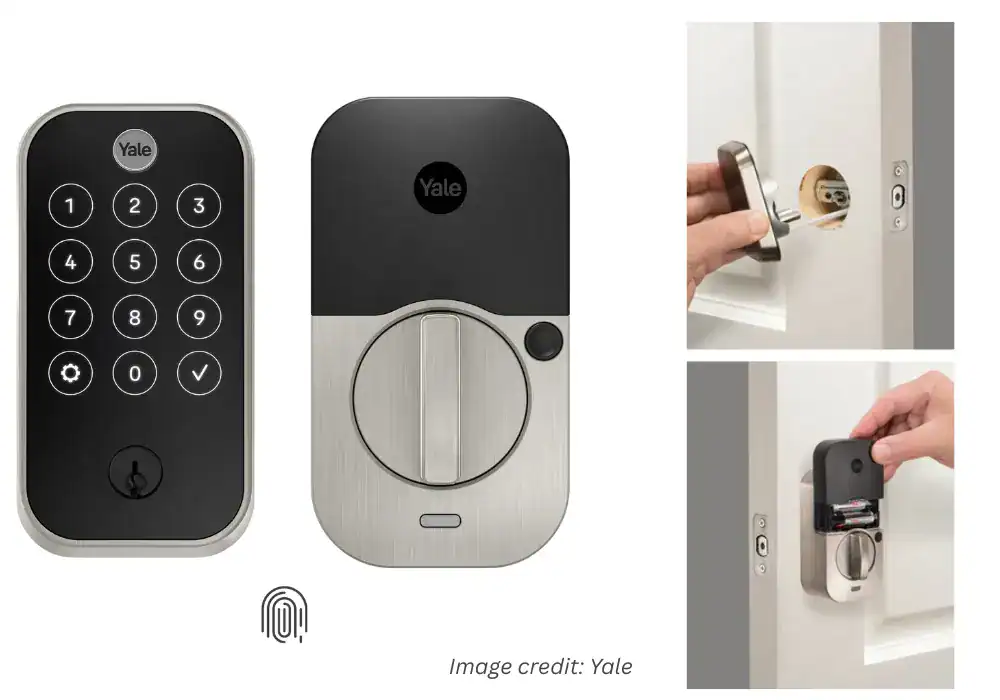
Yale Assure Lock 2 Touch
Ease of use and straightforward installation process. Many appreciate the sleek design and the convenient keypad, along with the added security features.
Pros:
- Sleek Invisible Design
- Apple HomeKit Ready
- Strong Build Quality
- Auto-Lock & Geo-Fence
- Excellent Support
Cons:
- Unreliable Touch Unlock
- Installation Sensitivity
- High Price Point.
As an Amazon Associate, I earn from qualifying purchases. When you buy through my links, I may earn a commission — at no extra cost to you.
Why We Picked It
Ease of use and straightforward installation process. Many appreciate the sleek design and the convenient keypad, along with the added security features.
Who It's For
Perfect for anyone who wants something affordable, dependable, and easy to install.
Specs & Configuration
Table Summary: Pros and cons summary of the Yale Assure Lock 2 Touch — sleek design and Apple integration balanced by reliability issues.
The Physical Threat: Is a Smart Lock Weaker Than a “Dumb” Lock?
Okay, we’ve put the “Hollywood Hacker” to bed. My research made it clear that a digital breach of a quality smart lock is incredibly unlikely.
But that led me to the next logical question, one I saw pop up constantly in my research: what about the lock itself?
It’s a fair point. We’re adding motors, batteries, and circuit boards.
Does all that tech come at the cost of old-fashioned, physical strength? Is a smart lock just a pretty plastic shell that will fold under a solid kick, while a “dumb” lock is a solid chunk of steel?
This was a huge concern for me. The last thing I wanted was to trade a strong physical barrier for a convenient but weak one.
The Deadbolt Itself: Are They Hollow and Weak?
One of the most specific fears I encountered was the idea that the deadbolt—the actual metal bolt that extends into your door frame—is hollowed out on smart locks to make room for electronics.
This would be a massive security flaw. A hollow deadbolt would have the structural integrity of a soda can.
So, is it true?
For cheap, no-name, off-brand locks you might find on sketchy websites? Yes, it absolutely can be.
Some manufacturers cut every possible corner, and that includes drilling out the bolt, using cheap plastic components, and fabricating flimsy housings.
But for any reputable brand you should actually be considering? It’s a myth.
I needed to see this visually. Here’s a breakdown of what I found when comparing the common fears with the reality of a well-made smart lock from a brand like Schlage, Yale, or Level Bolt.


| Common Myth (The Fear) | Quality Lock Reality (The Truth) |
|---|---|
| 😱 Myth: “The deadbolt is hollow to fit the batteries.” | ✅ Reality: The deadbolt is solid, reinforced steel. The batteries and motors are housed in the interior assembly, completely separate from the bolt itself. |
| 😱 Myth: “The housing is just flimsy plastic.” | ✅ Reality: The exterior housing and critical components are made from high-density metals like zinc, engineered to resist impact, drilling, and weather. |
| 😱 Myth: “It’s easier to pry open with a crowbar.” | ✅ Reality: Proper anchoring is key. Quality locks include long strike plates and 3-inch screws that secure deep into the wall stud, not just the jamb. |
Seeing this laid out was a turning point. I realized I wasn’t comparing “smart vs. dumb” locks. I was comparing “well-made vs. poorly-made.”
A high-quality smart lock isn’t a traditional lock with a motor tacked on. It’s a high-security traditional lock that just so happens to also be smart.
The foundation of it all is still raw, physical strength.
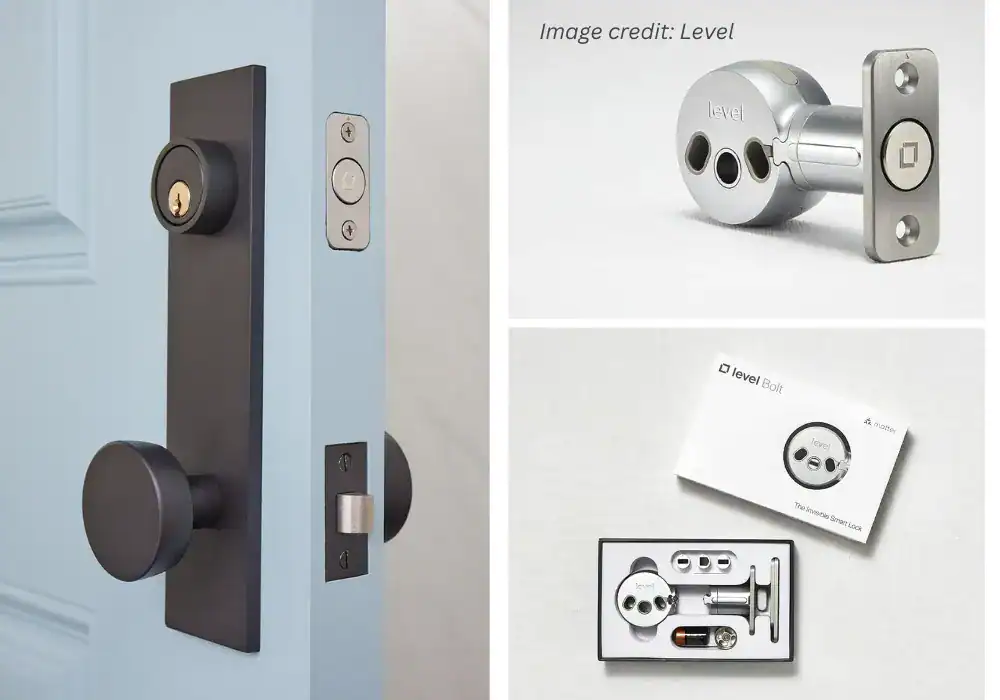
Level Bolt
All the smarts, completely hidden. Keep your home's original look.
Pros:
- A Completely Invisible Design
- Full Apple Home Key Support
- Protects Your Home’s Curb Appeal
- The Ultimate Minimalist Tech
Cons:
- Inconsistent “Touch to Unlock”
- Mechanical sensitivity and errors
- Intermittent HomeKit failures
As an Amazon Associate, I earn from qualifying purchases. When you buy through my links, I may earn a commission — at no extra cost to you.
Why We Picked It
All the smarts, completely hidden. Keep your home's original look.
Who It's For
Design-conscious homeowners who value aesthetics.
Specs & Configuration
Invisible Installation – Retrofit design fits inside your existing deadbolt, keeping your door’s exterior unchanged.;
Easy Setup – Installs in minutes with just a screwdriver;
fits most standard doors (2-3/8"
or 2-3/4"
).;
Long Battery Life – Hidden CR2 battery delivers over a year of use.;
Auto-Lock &
Unlock – Uses geofencing to secure your door automatically when you arrive or leave.;
Secure Construction – 6-stage stainless steel gearbox meets top industry standards.;
Shared Digital Access – Grant and manage keys for family, guests, or service providers via the Level app.
Table Summary: Comparison of Level Bolt advantages and drawbacks — discreet, elegant smart lock with a few reliability and installation sensitivities.
Understanding Security Grades: What ANSI/BHMA Ratings Actually Mean for You
As I dug deeper into the physical security of locks, I kept seeing the same acronyms: ANSI and BHMA.
It turns out, these aren’t just marketing fluff. They represent a standardized, rigorous testing process that separates the serious security hardware from the pretenders.
- BHMA (Builders Hardware Manufacturers Association) creates the standards.
- ANSI (American National Standards Institute) accredits them.
Think of it as a final exam for locks. To earn a grade, a lock is subjected to a battery of brutal tests: smashing it with a sledgehammer, trying to rip it out of the door, attacking it with drills, and putting it through hundreds of thousands of lock/unlock cycles to test its durability.
The results are boiled down to a simple grading system. Here’s what it means for you, in plain English:
| Grade | What It Means | Who It’s For |
|---|---|---|
| Grade 1 | Strength: The Highest Level of Security. Built for commercial use (hospitals, government buildings) but available for homes. It withstands extreme attacks and is rated for at least 1 million cycles. | Recommendation: For anyone wanting the absolute best, no-compromise front-door protection. Maximum peace of mind. |
| Grade 2 | Strength: Excellent Residential Security. A strong standard for most homes. Resists common break-in attempts and rated for around 400,000 cycles. | Recommendation: The best balance of strength and cost for the majority of homeowners. |
| Grade 3 | Strength: Basic Residential Security. The minimum acceptable grade. Offers limited durability and resistance. | Recommendation: Avoid for front doors. Suitable only for interior or low-risk doors. |
When I was shopping, I made a simple rule for myself:
I would only consider locks with an ANSI/BHMA Grade 1 or Grade 2 rating.
This single filter instantly cut out the cheap, unreliable junk. It’s a clear, independent stamp of approval that proves the lock can take a punch.
The Lockpicking Lawyer Test: What About Picking the Backup Keyhole?
You can’t research lock security in the 2020s without falling down the LockPickingLawyer YouTube rabbit hole.
I have to be honest, watching him open a $200 deadbolt in ten seconds with a couple of simple tools gave me a fresh wave of anxiety. It made me question if any keyed lock, no matter how “high-security,” was truly safe from a skilled attacker.
He proves, time and again, that the physical keyhole is often the weakest link.
So, what’s the solution?
For me, the answer was surprisingly simple. If the keyhole is the problem, get rid of the keyhole.
This is where a new category of smart locks offers a powerful security advantage. Key-free models, like the Yale Assure Lock 2 Key-Free Touchscreen, eliminate that attack vector entirely.
▶︎ There is no keyway to bump.
▶︎ There is no cylinder to drill.
It transforms the lock from a complex mechanical puzzle into a solid, seamless block of metal from the outside. For a thief who relies on traditional lock picking skills, it’s a complete dead end.
This was a profound realization for me. A smart lock, in this case, wasn’t just as secure as a traditional lock—it was demonstrably more secure by eliminating a centuries-old vulnerability.
Of course, this brings up the valid fear of being locked out if the electronics fail, which is a topic we will cover in-depth shortly. But from a pure “unauthorized entry” perspective, going key-free is a significant security upgrade.
Yale Assure Lock 2 Touch
The Most Common Question: “Won’t They Just Break a Window?”
After all the research into digital encryption, ANSI grades, and lock-picking, I kept coming back to one simple, nagging question. It was the most upvoted, most repeated comment I saw in every single online discussion.
“Who cares about hacking the lock? Won’t a burglar just break a window?“
The honest, direct answer?
Yes. They probably will.
And acknowledging that simple fact is the key to understanding the true purpose of any lock, smart or not. We spend so much time worrying about the high-tech, Mission: Impossible-style threats that we forget about the low-tech, brute-force reality of a break-in.
A determined criminal with a crowbar or a large rock doesn’t care about your lock’s encryption standard. Your front door is just one of many possible entry points.
So, if that’s the case, why bother with a good lock at all? Is it all just “security theater“?
No. It’s because we’re thinking about the lock’s job all wrong.
Thinking in Layers: Your Lock is Just One Part of Your Home Security
The biggest mistake I was making was thinking of my front door lock as a magic force field. It’s not.
A lock is not an impenetrable barrier. It’s a deterrent and a delay tactic.
True home security isn’t a single product; it’s a system of layers working together. I found it helpful to visualize it like this:
| Security Layer | Its Job in the System | How a Smart Lock Helps |
|---|---|---|
| Layer 1: The Deterrent | Purpose: Make your house look like a bad choice. Examples: visible cameras, motion lights, “Beware of Dog” signs. | Effect: A modern smart lock signals the home is maintained and monitored, discouraging opportunistic intruders. |
| Layer 2: The Barrier | Purpose: Physically slow down an intruder with strong structural elements. | Effect: A Grade 1 or 2 smart lock strengthens the door’s resistance, making forced entry significantly harder. |
| Layer 3: The Alert | Purpose: Detect and notify instantly when a breach is attempted. | Effect: Smart locks can trigger alerts when tampered with, acting as an early-warning device in your system. |
Your lock’s main job is to win the battle against the casual, opportunistic threat and to slow down the more determined one, giving your other security layers time to kick in.
Yale Assure Lock 2 Touch
Check Price on AmazonThe Real-World Burglar vs. The Mythical Hacker
This brings us back to the mindset of a real criminal.
I read a fascinating interview with a former burglar who laid it out perfectly. He said his entire process was about speed and noise. He wanted to be in and out in under five minutes. Anything that caused a delay or made a loud, attention-grabbing noise was a deal-breaker.
Let’s put ourselves in his shoes. What’s the faster, quieter, and less risky option?
| Scenario A The House with a Cheap, Old Lock |
Scenario B The House with a Quality Smart Lock |
|---|---|
|
Reality: The intruder can kick the door in. A loud bang, but it’s quick. Or, with basic skills, he can pick or bump the lock in under a minute — quiet and efficient. |
Reality: Kicking the door is much harder thanks to reinforced strike plates. It may take multiple kicks, each louder and riskier. Picking is not possible on a key-free model. Hacking is a non-starter. The intruder’s only remaining option is a loud, messy window smash. Outcome: Smashing a window is a burglar’s last resort — loud, attention-grabbing and dangerous. |
By having a strong, high-quality lock, you force the potential intruder to take the loudest, riskiest, and most conspicuous route. You make your house a less attractive target. And that, right there, is the true definition of security.
My Biggest Anxiety Wasn’t Hacking, It Was Failure: What if I Get Locked Out?
After settling my fears about digital and physical break-ins, I was left with one final, nagging anxiety. In many ways, it was the most realistic one.
It wasn’t about a shadowy hacker or a crowbar-wielding burglar.
It was about me, standing in the pouring rain with bags of groceries, my phone dead, and the lock’s batteries finally giving up the ghost.
The fear of being locked out of my own home by the very device meant to make my life easier was, frankly, paralyzing. This is the “smart brick” scenario I dreaded—spending hundreds of dollars just to trade one problem (lost keys) for a much, much worse one.
I needed to know: what happens when things go wrong?
The “Dead Battery” Nightmare and How to Avoid It
The number one failure point I worried about was the battery. What if it just dies without warning?
Here’s what my research taught me: a quality smart lock will not let its battery die without a fight.
Reputable manufacturers have built in multiple layers of warnings precisely because they know this is our biggest fear. It’s not a sudden death; it’s a slow, very loud cry for help.
Here’s the typical process, which I’ve organized into a simple “Defense Against Dead Battery” checklist:
Your Smart Lock’s Defense System:
✅ Step 1: The Early Warning (Weeks in Advance)
You’ll get a notification in the app saying “Battery Low” when it hits around 20-25%. This isn’t a “change it now” panic; it’s a “hey, pick up some AAs next time you’re at the store” reminder.
✅ Step 2: The Physical Reminder (Days to Weeks)
The lock itself will start to protest. Many models will flash a red light on the keypad or beep differently when you lock or unlock the door. You can’t miss it.
✅ Step 3: The Last Gasp (The Day Of)
Even when critically low, most locks reserve just enough power for a few more operations. They are designed to fail gracefully.
✅ Step 4: The Emergency Jump-Start (The “I Ignored Everything” Scenario)
This is the feature that finally gave me peace of mind. What if you ignore all the warnings? Almost every major smart lock (including all the ones I recommend) has two small terminals on the bottom. You can take a standard 9-volt battery, press it against these terminals, and it will give the lock just enough power to operate the keypad so you can enter your code. It’s the ultimate backup plan.
Once I understood this, the dead battery nightmare faded away. It’s a problem with a simple, built-in solution.
Of course, the most foolproof backup is the one we’ve known for centuries: a physical key. And that’s why, for many people, choosing a model that still includes a hidden keyway is the ultimate safety net.
Schlage Encode Plus
If that peace of mind is non-negotiable for you, the Schlage Encode Plus is a perfect example of a lock that masterfully blends high-tech features with this essential, low-tech backup. You can see its features right here:
Choosing Reliability: Why Brand Matters
All these safeguards—the battery warnings, the 9V jump-start, the quality of the encryption—depend on one thing: the manufacturer caring enough to implement them properly.
During my research, I saw a clear dividing line.
On one side, you have the established, household names. On the other, a sea of cheap, generic brands with names that look like a cat walked across a keyboard.
This isn’t about being a brand snob. It’s about risk and reliability. When you buy a lock from a company that has been in the security business for over a century, you’re buying more than just a product. You’re buying a track record.
- You’re buying decades of engineering and refinement.
- You’re buying a customer support team you can actually call.
- You’re buying a warranty that will actually be honored.
- You’re buying the trust that their app will be maintained and updated, not abandoned in a year.
This is why my final recommendations always lean towards the titans of the industry. They have a reputation to uphold that a fly-by-night seller simply doesn’t. When it comes to the security of your home, trust is everything.
I spent a huge amount of time comparing the two biggest names in the business. If you want to understand the subtle but important differences in their approach to smart security, you can read my deep dive here: Schlage vs Yale (2026): Which Legacy Lock Brand Makes the Best Smart Lock?
So, Are Smart Locks Safe? My Final Verdict.
After weeks of diving into the world of digital encryption, physical stress tests, and real-world break-in scenarios, I can finally answer the question that started this whole journey.
Are smart locks safe?
The Big Yes.
A good smart lock is not only as safe as a high-quality traditional deadbolt, but in some ways, it’s even safer.
It’s safer because it can automatically lock itself, eliminating the human error of forgetting. It’s safer because it can alert you instantly if it’s tampered with.
And if you choose a key-free model, it’s safer because it completely removes the risk of lock-picking.
But that “yes” comes with a crucial condition.
Yale Assure Lock 2 Touch
Yes, If You Choose Wisely and Practice Good Digital Hygiene.
The security of your front door is no longer just about the strength of the steel. It’s a partnership between a reliable piece of hardware and a responsible owner.
You can’t buy a cheap, no-name lock and expect top-tier security. And you can’t buy the best lock on the market and then “protect” it with a Wi-Fi password of 12345678.
Safety comes from the combination of a trusted product and smart habits. The manufacturer is responsible for building a digital and physical fortress.
You are responsible for properly guarding the keys to that fortress—your passwords and your network.
A Quick Checklist for Anyone Asking “Are Smart Locks Safe?
My journey through all this information was overwhelming at times. To make it simple, I’ve boiled down my key learnings into a final checklist. If you’re considering a smart lock, just make sure it ticks these boxes.
This is the exact list I used to gain confidence in my final choice.
The 5-Point Smart Lock Security Checklist:
✅ Reputable Brand Is a Must: Stick with established names that have a long history in security (like Schlage, Yale, Level Bolt). Their reputation is your first line of defense.
✅ Check the Grade (ANSI/BHMA): Look for a Grade 1 or Grade 2 rating on the box or in the specs. This is non-negotiable proof of physical strength and durability.
✅ Know Your Backup Plan: How will you get in if the batteries die? Ensure the lock has either a 9V battery jump-start terminal on the exterior or a well-hidden physical key backup.
✅ Practice Good Password Hygiene: The lock’s encryption is useless if your Wi-Fi or app password is weak. Use long, random passwords and enable Two-Factor Authentication (2FA) everywhere you can.
✅ Consider Going Key-Free: If your biggest fear is someone picking your lock, the most secure solution is to choose a model that doesn’t have a keyhole to begin with.
That’s it. If you follow these five points, you can be incredibly confident that you’re making a smart, secure upgrade to your home. You’re not just buying a gadget; you’re investing in a system that offers both convenience and real-world peace of mind.
Level Bolt
My goal with this article was to give you the clarity and confidence to make the right choice for your home. Now that you know what makes a smart lock safe, you’re ready for the next step.
If you want to see the specific models that I personally trust and that excel in all these security areas, I’ve put together a detailed guide with my hands-on research.
Best Smart Locks of 2026 — Tested for Reliability, Security & Real-Life Use